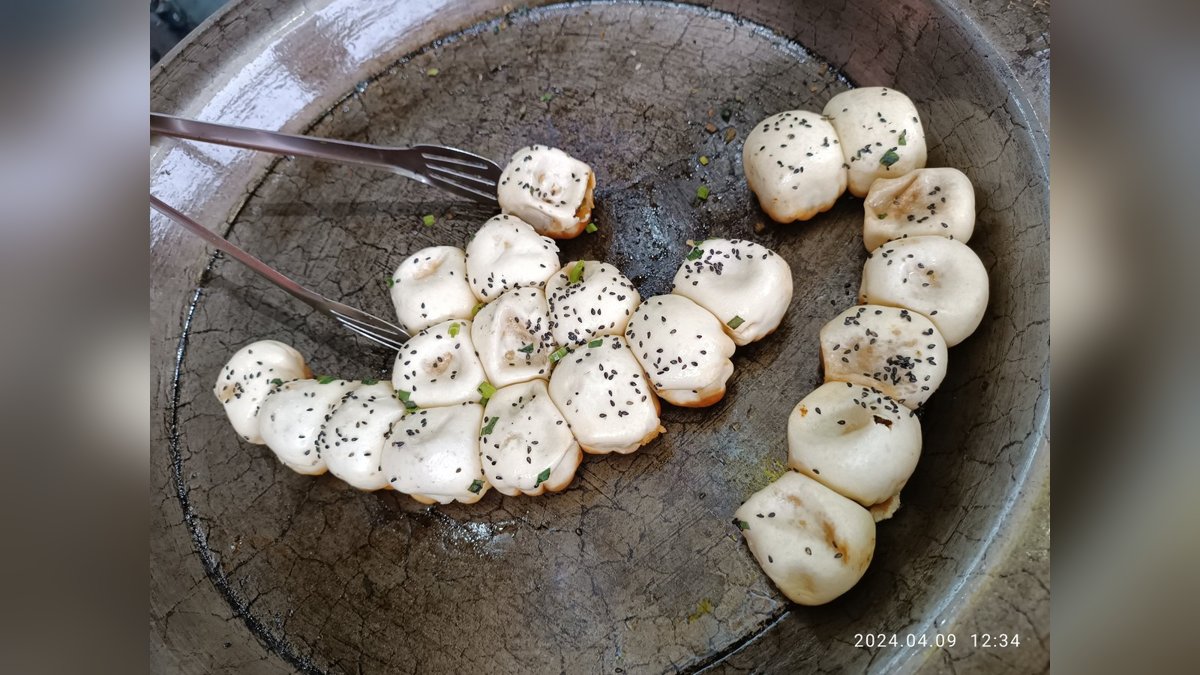
What Makes Shengjian Bao Unique: The Anatomy of a Pan-Fried Masterpiece
Shengjian Bao, often called Shanghai's pan-fried pork soup dumplings, is a street food icon that deserves far more international recognition than it currently receives. Unlike its steamed cousin xiaolongbao, shengjian bao undergoes a dual cooking process that creates a textural symphony: a crispy, golden-brown bottom from pan-frying, while the top remains soft, fluffy, and steamed. Each dumpling is roughly the size of a golf ball, with a thick, yeasted wrapper that encloses a savory pork filling and a rich, gelatinous broth that turns into soup when heated.
The name itself breaks down into 'shengjian' (), meaning 'raw-fried,' and 'bao' (), meaning 'bun.' This describes the cooking method precisely: raw buns are placed bottom-down in a wide, flat pan with oil, then fried until the bases turn crisp. A mixture of water and flour is added, and the pan is covered to steam the tops. The result is a dumpling with three distinct textures: a crackling crust, a tender steamed dome, and a juicy, soup-filled interior. A typical shengjian bao weighs about 50-60 grams and contains roughly 15-20 milliliters of broth per piece.
According to Shanghai street food historian Chen Wei, 'A proper shengjian bao should have a bottom so crispy it shatters when bitten, yet the wrapper must be thin enough to release a burst of hot soup without tearing.'
The filling is traditionally a mixture of ground pork, ginger, scallions, soy sauce, and sugar, with aspic (pork skin gelatin) folded in to create the soup. The aspic melts during cooking, transforming into a rich, savory broth that gushes out with the first bite. The top of each bun is typically garnished with black sesame seeds and chopped scallions, adding nutty and fresh notes that balance the richness of the pork.
The History of Shengjian Bao: From Shanghai's Streets to Global Fame
Shengjian bao originated in Shanghai in the early 20th century, specifically in the 1920s, when street vendors began experimenting with pan-frying leftover steamed buns to extend their shelf life. The technique quickly evolved into a deliberate cooking method, and by the 1930s, shengjian bao had become a staple of Shanghai's breakfast and snack culture. The first recorded shop specializing in shengjian bao was 'Da Hu Chun' (), established in 1932 on Sichuan Road in Shanghai's Huangpu District. Da Hu Chun remains open today and is widely regarded as the birthplace of the 'Shanghai-style' shengjian bao, characterized by a thicker, yeastier wrapper and a drier, less soupy filling compared to later variations.
During the 1950s and 1960s, shengjian bao spread throughout Shanghai's working-class neighborhoods, sold from small storefronts and street carts. The dumplings were affordable--costing just a few fen (Chinese cents) each--making them accessible to factory workers, students, and families. By the 1980s, as China's economy liberalized, shengjian bao shops proliferated across the city, with each district developing its own style. The 'Yang's' style, popularized by Yang's Fried Dumplings () founded in 1994, introduced a thinner wrapper, more soup, and a larger size, appealing to modern tastes. Today, Yang's operates over 100 locations in Shanghai and has expanded to other Chinese cities and overseas markets.
In 2018, shengjian bao was officially recognized as an 'Intangible Cultural Heritage' item by the Shanghai municipal government, cementing its status as a cultural treasure. The recognition has spurred efforts to preserve traditional techniques and ingredients, even as modern variations--such as cheese-filled or spicy shengjian bao--emerge. Despite its deep roots, shengjian bao remains relatively unknown outside of China compared to xiaolongbao or jiaozi. However, with the rise of Chinese diaspora communities and food tourism, it is gradually gaining a global following. In 2022, a shengjian bao pop-up in New York's Chinatown sold over 3,000 dumplings in its first weekend, signaling growing international demand.
How to Eat Shengjian Bao: The Art of Avoiding Scalding
Eating shengjian bao requires technique. The soup inside can reach temperatures of 180°F (82°C) immediately after cooking, and biting into a dumpling carelessly can result in a burned tongue or a messy splatter. The proper method, as practiced by Shanghai locals, involves three steps. First, pick up the dumpling with chopsticks and gently bite a small hole in the side of the wrapper, near the top. Second, blow on the opening to cool the soup inside for about 10-15 seconds. Third, sip the broth through the hole, then dip the dumpling in Zhenjiang black vinegar (with or without shredded ginger) before eating the rest in one or two bites.
The vinegar is not merely a condiment; it cuts through the richness of the pork and enhances the umami of the broth. Some purists argue that ginger should be avoided because it overpowers the delicate flavor of the soup, while others insist it aids digestion. The choice is personal. A typical serving of shengjian bao is four to six pieces, often accompanied by a bowl of clear soup or a glass of cold soy milk. The dumplings are best eaten fresh from the pan, within two minutes of cooking, as the crispy bottom softens quickly from the steam.
For those new to shengjian bao, it is advisable to start with a smaller portion and eat slowly. The soup can be deceptively hot, and the combination of hot broth and crispy crust can be overwhelming. Many first-timers make the mistake of biting directly into the dumpling, resulting in soup shooting across the table. Practice makes perfect, and after a few attempts, the technique becomes second nature. In Shanghai, it is common to see locals eating shengjian bao while walking, using a paper wrapper to catch drips--a testament to the dumpling's role as a true street food.
Where to Find the Best Shengjian Bao in Shanghai and Beyond
Shanghai remains the undisputed capital of shengjian bao, with thousands of shops across the city. The two most famous chains are Da Hu Chun and Yang's Fried Dumplings, each representing a distinct style. Da Hu Chun, the original, offers a traditional version with a thick, fluffy wrapper, a relatively dry filling, and a moderate amount of soup. Their signature is the 'pork and crab roe' shengjian bao, available seasonally from September to November, which adds a briny, luxurious note to the filling. A plate of four costs approximately 12 RMB (about $1.70 USD). Yang's, on the other hand, serves a modern interpretation with a thin, almost translucent wrapper, an abundance of soup, and a larger size (about 80 grams per dumpling). Their original pork shengjian bao is the most popular, but they also offer shrimp and vegetable varieties.
Beyond the chains, hidden gems abound. 'Fengyu Shengjian' () in the French Concession is beloved by locals for its balanced flavor and consistently crispy bottoms. 'Lao Shanghai Shengjian' () near the Bund offers a no-frills experience with dumplings cooked in massive batches on cast-iron pans. For the adventurous, 'Wang Jia Sha' () in Jing'an District serves a unique 'soup dumpling shengjian' that combines the thin wrapper of xiaolongbao with the pan-fried technique of shengjian bao--a hybrid that has gained a cult following. Outside of China, cities with large Chinese populations, such as New York, San Francisco, London, and Sydney, have seen a surge in shengjian bao offerings. In New York, 'Shanghai 21' in Flushing and 'Joe's Shanghai' in Chinatown both serve respectable versions, though purists note that the quality rarely matches that of Shanghai's street stalls.
For home cooks, making shengjian bao is a rewarding but labor-intensive project. The key is the aspic: pork skin simmered with ginger, scallions, and Shaoxing wine for at least two hours, then chilled until firm. The dough requires a yeasted mixture that is kneaded until smooth and rested for one hour. Filling the buns and pleating the tops takes practice, but the result is a batch of 20-30 dumplings that can be frozen and pan-fried on demand. Online tutorials from Chinese cooking channels like 'Chinese Cooking Demystified' and 'The Woks of Life' provide step-by-step instructions. A homemade shengjian bao, while not identical to a street vendor's, offers the satisfaction of mastering one of China's most beloved street foods.
The Science Behind the Perfect Shengjian Bao: Why Technique Matters
The perfect shengjian bao is a study in contrasts: crispy and soft, savory and sweet, hot and cool. Achieving this balance requires precise control of temperature, moisture, and time. The pan-frying process begins with a generous amount of oil--typically 2-3 tablespoons per batch--heated to around 350°F (175°C). The raw buns are placed bottom-down in the oil and fried for 2-3 minutes until the bases are golden brown. Then, a mixture of water and a small amount of flour (about 1 tablespoon per cup of water) is poured into the pan, immediately covered, and the heat is reduced to medium-low. The water creates steam that cooks the tops of the buns, while the flour thickens the liquid into a thin starch slurry that, when evaporated, leaves an extra-crispy, lacy crust on the bottom.
The science of the soup lies in the gelatin. Pork skin contains collagen, which, when simmered, breaks down into gelatin. At room temperature, gelatin forms a semi-solid gel that can be chopped and mixed into the filling. When heated, the gelatin melts at around 95°F (35°C), turning into a liquid that remains trapped inside the dough wrapper. The key is to use enough gelatin to create a substantial broth without making the filling too wet. A ratio of 1 part gelatin to 4 parts ground pork is standard. The broth itself is seasoned with soy sauce, sugar, and white pepper, and sometimes enhanced with chicken stock or dried shrimp for extra umami.
Temperature control is critical. If the pan is too hot, the bottoms burn before the tops cook through. If too cool, the buns absorb oil and become greasy. The ideal pan temperature during the steaming phase is around 212°F (100°C), the boiling point of water. The lid must fit tightly to trap steam; a glass lid is useful for monitoring progress without releasing heat. After 8-10 minutes of steaming, the lid is removed, and the heat is increased to evaporate any remaining liquid, crisping the bottoms further. The final 1-2 minutes of uncovered frying are what create the signature crackling crust. A well-made shengjian bao should have a bottom that shatters with a audible crunch, a top that is pillowy and slightly sweet from the yeast, and a filling that releases a burst of hot, savory soup with every bite.